
SS003 - Yung Lean
The dragon rests in agony.
Playlist: Spotify.

I don’t know exactly when I became aware of the music of Yung Lean. But it was almost certainly via the music video for “Hurt,” which if you haven’t seen, you should:
This song was released in 2013, just as I was beginning a grad program studying American popular culture, so you can imagine how worked up I got watching a 16-year-old Swedish kid making music out of the most normal bullshit-ass garbage from the US: wearing sunglasses and a bucket hat, waving an N64 cartridge and an Arizona iced tea, intoning Louie duffle bag filled with heroin / I’ma make you hurt.
“Hurt” is a near-perfect piece of postmodern art, ironizing the tropes of teenage angst by juxtaposing the detritus of American consumer culture with the nostalgic sonics of Atlanta-Houston hip-hop and video game music. But it is also deeply melancholy. For Lean, the images and language which we use to communicate with one another are themselves corrupted, meaningless, empty, just so much more noise in the wind.
Over the last decade, this sense of alienation has come to form the emotional core of Lean’s music. It’s in the instrumentals he chooses, full of simple, sweet minor-key melodies, drowning in reverb and delay, floating over roaring basslines and skittering 808s. And it’s all but explicit in his lyrics, which continually juxtapose a longing for tenderness with an unanswering impersonal void: Sunrise angel, page unavailable. Lean’s autotoned vocals rise just above a mumble in many of these songs, his natural monotoned drawl sinking into the sounds around him. The albums from 2014 until 2020 go deeper and deeper into this sound, mining a vein of sadness the bottom of which he could not seem to find.
I found Lean’s music entrancing almost immediately, perhaps because, at the beginning, I was 23 and living in a studio apartment that I typically did not leave between Friday evening and Monday morning. When I did leave, I would drive around the suburban streets, windows down, blaring “Kyoto” or “Blinded,” feeling like a portal to another dimension had opened inside of my Japanese hybrid hatchback for the just-under-four-minutes it took to get to the grocery store. These songs provided for me a very powerful catharsis, a dramatized isolation that I could pour myself into: Watching horses in the fields, the dragon rests in agony. When I’m afraid, I lose my mind. It’s fine, it happens all the time. A friend and I went to see Lean perform in San Francisco, standing in a mob of would-be Sad Boys to watch Lean dance around in Uggs and smoke blunts, before getting so tangled up in string lights he fell over and someone had to help him get up.
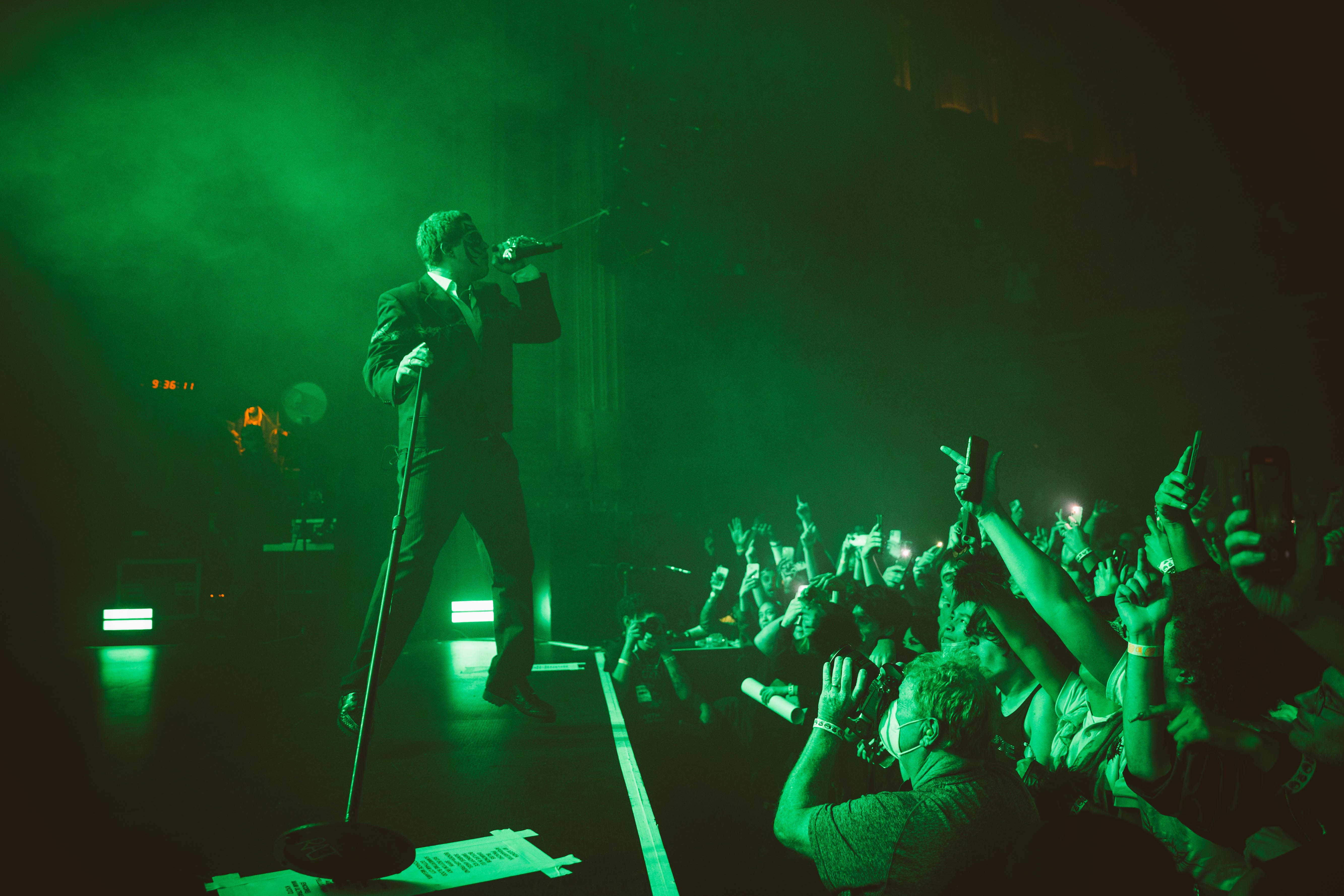
Lean’s sound has changed a great deal in the last five years, welcoming in many other influences, collaborators, modes: pop balladeer, psychedelic wedding singer, graveyard mourner, performance artist. His music is refreshingly unvarnished now, his untrained voice more frequently presented directly atop an electric guitar or a piano, singing plainly and without pretense or nuance. This sound is perhaps truer to the original spirit of the project, which started from, well, a group of teenagers just pretty much fucking around, doing whatever they liked or made them laugh or seemed exciting without worrying too much about sounding sophisticated.
And he has evolved a deeper (and more specific) visual mythology as well, becoming more comfortable indulging his instinct to find the weirdest or most unusual or unexpected choice in any setting: stunting in the most garish and outre clothes, cheap haircuts and mismatched dye-jobs, mismatched layers, mall-core designer accessories, deathcore tattoos of spiderweb inscriptions mixed with Disney characters and costume jewelry. Today’s version of Lean (now evidently a year-ish sober) has replaced the irony of his teenage years with a precise but very uncalibrated ugliness, an anti-fashion so shockingly unique and stylish. He performs now on Tower-of-Babel-esque monolith, built of broken wooden staves, holding a microphone with baroque, stylized angel wings.

His music is much sadder this way, somehow, and also much wider, broader, less focused and more experimental; he is risking more, hiding less. Pleasantly, one of the things he seems to be experimenting with is simplicity. By reducing the noise, he seems to have a found a way to more directly tap the deep, cold lake of feeling surging within him.
Playlist: Spotify. I couldn’t help myself and added many bonus songs this week, but the first seven are my miniature mixtape, how I would introduce his music and career.
“Afghanistan”
This is the median Lean tune to my ears, from the period in which he was trying his hardest to make American rap music. A simple repeated hook, an abstract synth lead drowning in reverb, a deep and abiding sense of misery that can’t quite be nailed down… this could have been a Travis Scott song.
“Hennessy & Sailor Moon”
Potentially the greatest love song ever written. I don’t like Hennessey or Sailor Moon and this song makes me want both of them. Another archetypal Lean beat, with the two or three note synth melody over the chorus chorus endowing it with a suggestion of intimacy that never quite surfaces.
“Colours of Tomorrow” - jonatan leandoer96
A truly haunting ballad released in 2020 under Lean’s own name (sort of), this is his singer-songwriter side coming to the foreground, drenched in strings and filter-sweeps. I love how this song highlights his voice, totally unalloyed, pitchy and close-miked; it sounds like voice memo recorded late at night, something personal and near.
“silicon wings”
This song marks a transition in Lean’s music - not a complete change but a shift towards something approaching earnestness, a kind of peace with directness that only accelerates in his music after this point.
Touch me, go on, feel me
Heal me, like you would care for me?
Touch me, decompose me
Heal me, don’t you want to see the real me?
Thrill me, kill the real me
Thrill me, you by my side but are you really with me?“Yoshi City”
One of the consistent features of Lean’s music videos are these strange, almost medieval settings: a cave, an empty mansion, a castle, a forest. Juxtaposing the ancient or the epic with the electronic and the contemporary is startling and heightens the sense of isolation, of lost-ness. Squad up and we ridin’ out.
“I’m Your Dirt, I’m Your Love”
In an interview I watched the other day Lean talks about feeling like his hooks were good enough to write for pop stars and wishing he was called to do that more frequently. This could be a Taylor Swift song with basically no changes but I think unfortunately then it wouldn’t be a Yung Lean song, so I hope his phone keeps not ringing.
“Red Bottom Sky”
This is the song that I have come back to the most in Lean’s catalogue. There are few songs I can think of that breathe peace into my soul as “Red Bottom Sky” does: the bass melody turning over and over, filtered drums clicking along without hurry, Lean’s breathy vocals floating on top. But it’s the crescendo at 4:00 that really does it for me, a moment in which the music seems to momentarily reach for the sublime, for catharsis, and fall just short, lapsing back into patient contemplation. The video captures this wonderful by showing Lean strapping on a helmet before climbing into a go-cart and disappearing down a densely forested road. May we all one day experience peace like this.